Monday, June 11, 2012

Surrealism


SURREALISM
(Started: 1924)
(Ended: Late 1966)
The movement was founded in Paris by the poet Andre Breton and it maintained Dadaist artists’ search for irrational and destructive things in the art. Surrealism aimed at creating the “automatic art” that comes directly from the subconscious and that is not shaped up by logical, moral, or aesthetic judgments. Subconscious was the main interest of the Surrealists. To them, subconscious was a large storage which is full with artistic creation and  has been suppressed till now, they saw the logic as a defender avoiding the entrance to this storage and they practiced various ways to unlock the entrance of subconscious. Surrealist artists blamed Naturalism and Realism for confusing the realities with objects and for approaching both to art and life in an ugly way as if they were old furniture. 
Main representatives were:
·         Andre Breton
·         Max Ernst
·         Salvador Dali
·         Pablo Picasso
·         Man Ray
 Salvador Dali
            Salvador Dali is of the most sophisticated and productive artists of the twentieth century. He is mainly known for his painterly works, but he turned to sculpture, printmaking, fashion, advertising, writing, and filmmaking in his long career life. He was renowned for his flashy character and for his indisputable technical mastership. Dali’s paintings reveal an attraction for Classical and Renaissance art, obviously apparent through his extremely realistic style and religious symbolism of his later achievements. He is mostly related with the Surrealist movement, although he was formally dismissed from the group in 1934 for his regressive political views.
 Sources:

Isms: Understanding Art by Stephen Little
            http://www.theartstory.org/movement-surrealism.htm
            http://www.theartstory.org/artist-dali-salvador.htm

Sunday, June 10, 2012

Pittura Metafisica


PITTURA METAFISICA

(Started: 1910)
(Ended: 1921)

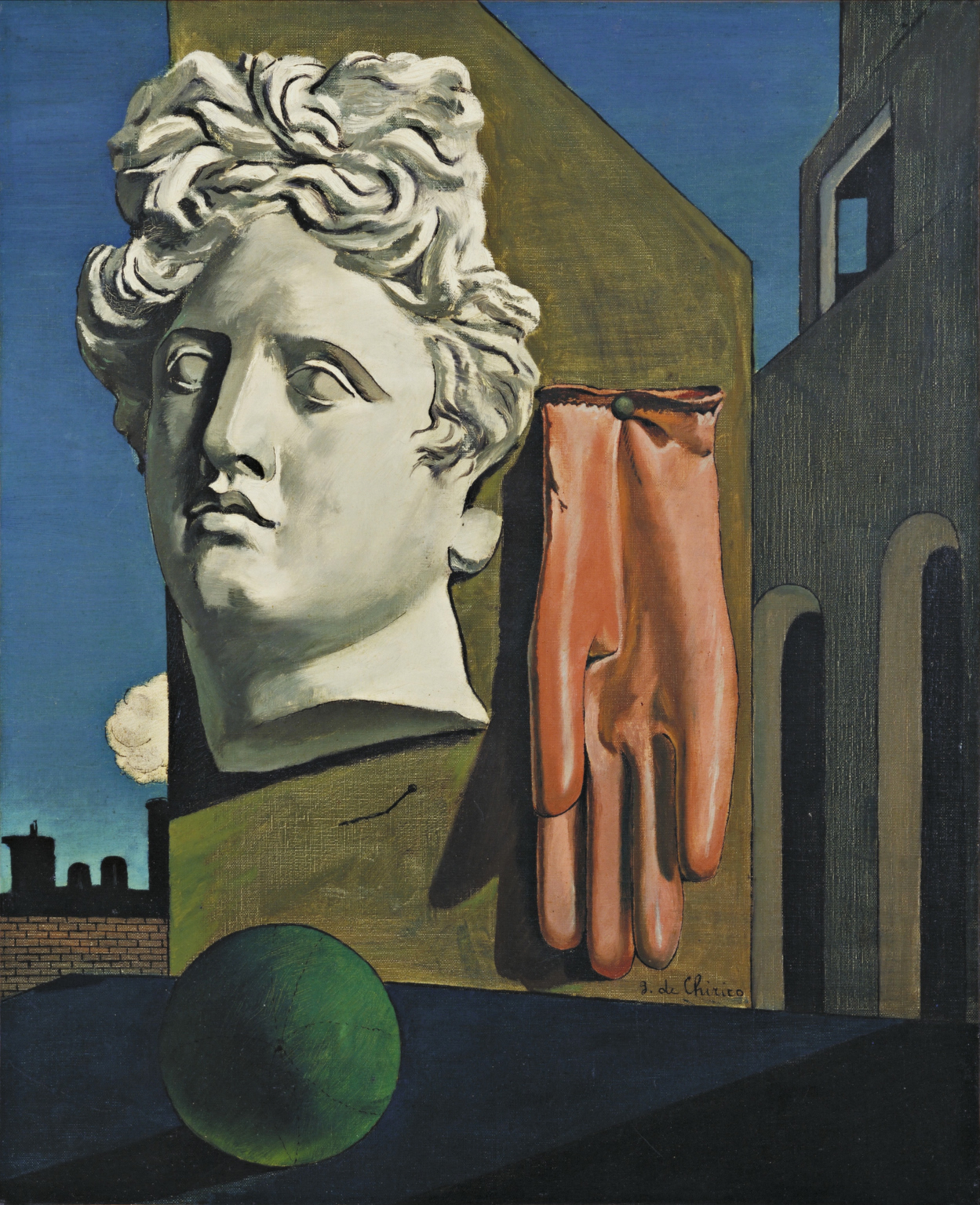
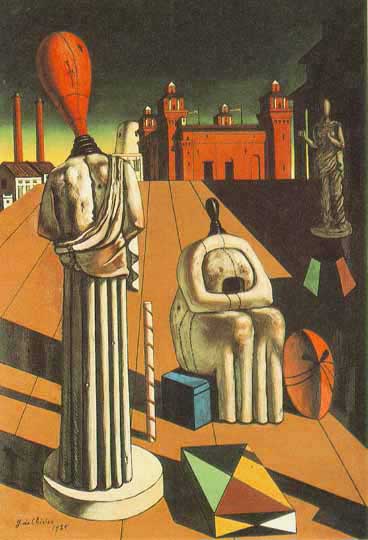
            Pittura Metafisica, Metaphysical Painting, is an art movement; a painting style began in Ferrara. The word metaphysical is the essence for the poetics of the movement. Metaphysical Painting artists represented dreamlike scenes having forms that look like frozen in time. Though they adopted depicting the visible world in the conventional manner, they preferred fool-like human forms, objects in absurd states, and delusive colors in their paintings. Providing a new perspective for seeing the world, Metaphysical Painting was a reaction to Futurism. There was the sense of uncertainty in terms of time and space in the works. They were mysterious paintings with no events. All these things created a new concept that is beyond the meaning of what is presented.


 Main representatives were:
·         Giorgio de Chirico
·         Carlo Cara
·         Giorgio Morandi
·         Italo Savino

Giorigo de Chirico

            Born in Volos, Greece, he was raised by Italian parents. He was a leader in the rebirth of Classicism which became a Europe-wide phenomenon in the 1920s. He is best known for the enigmatic paintings of empty town squares that he produced while living in Paris, suffering from homesickness. This work encouraged him to start the Metaphysical Art Movement, with the painter Carlo Carra. In the 1920s, his style started to obtain characteristics of Renaissance and Baroque art, however, he received criticism from his old followers after this move and this disapproval continued for many years. He could not achieve success with his new interpretations of Metaphysical paintings and backdating his work, but recently, his works has drawn attention, and it was effective on a new generation of Italian artists in the 1980s.


Sources:

            http://www.huntfor.com/arthistory/C20th/metaphyspaint.htm


DADA


DADA
(Started: 1916)
(Ended: 1924)
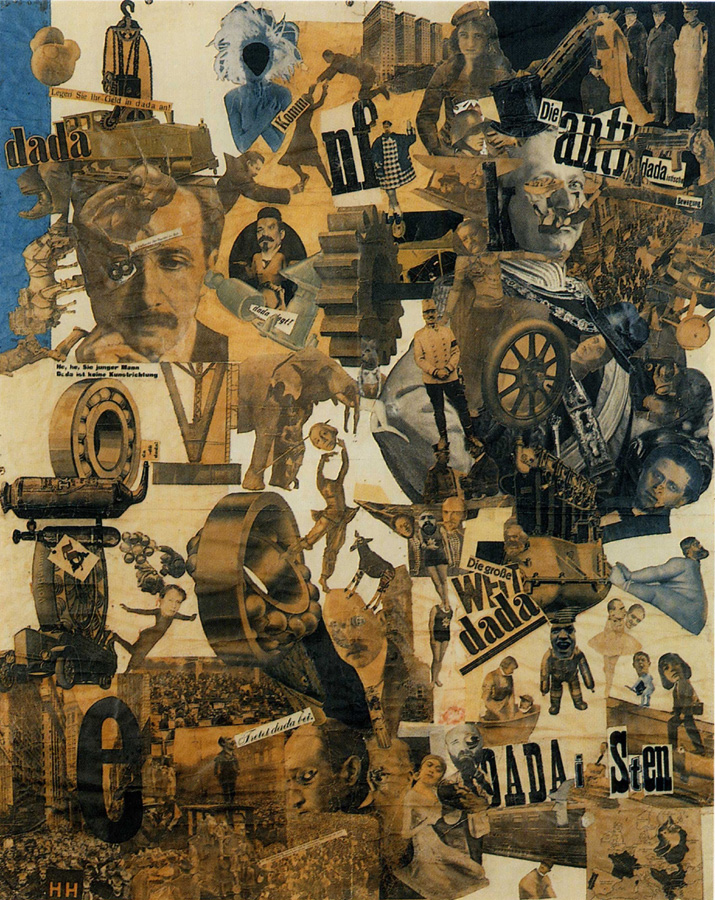
 Dadaism was an artistic and literary movement emerged during the World War I, in Zurich, Switzerland. The word “dada”, which means “hobby-horse” in French, was taken arbitrarily from a dictionary. Dadaist artists declared that all ethical, political, and aesthetic beliefs were ruined during the war. They supported a destructive, disrespectful, and liberating approach to art. Shocking was the basic tactic of Dadaists who hoped for society to leave the nationalism and materialism that caused the war and massacre. It was a literary movement as well as a visual one. Coincidence and senselessness was the main elements of the movement. A new conscious was defined with respect to the role of the subconscious in daily life and it objected developing an entire art theory that would be condemned to die in an art library. 
           Key artists:
·         Jean (Hans) Arp
·         Francis Picabia
·         Marcel Duchamp
·         Man Ray
·         André Breton
Francis Picabia
Francis Picabia was one of the main figures in the Dada movement both in Paris and New York. He was known for a rich variety of work ranging from strange, comic-erotic images of machine parts, to text-based paintings that foreshadow aspects of Conceptual art. Even after Dada had been supplanted by other styles, the French painter and writer went on to explore a diverse and almost incoherent mix of styles. He shifted easily between abstraction and figuration at a time when artists clung steadfastly to one approach, and his gleeful disregard for the conventions of modern art encouraged some remarkable innovations even later in his career, from the layered Transparencies series of the 1920s, to the kitsch, erotic nudes of the early 1940s. Picabia remains revered by contemporary painters as one of the century's most intriguing and inscrutable artists.


 Sources:
           
Isms: Understanding Art by Stephen Little
http://www.theartstory.org/movement-dada.htm
http://www.theartstory.org/artist-picabia-francis.htm
http://www.huntfor.com/arthistory/C20th/dadaism.htm

Synchromism

 
SYNCHROMISM

(Started: 1912)

            Synchromism is an art movement founded by Stanton MacDonald-Wright and Morgan Russell in Paris that focused on color. It was the first abstract art movement pioneered by American artists. The main idea was that the color and the sound were similar: These artists thought that the colors of a painting could be arranged harmoniously just like the notes in a symphony, and they believed that their paintings could evoke musical sensations with the utilization of color scales. So their abstract paintings, which they called "synchromies", were based on color scales with advancing and reducing hues. They had exhibitions in Paris, Munich, and New York. These abstract synchromies were new in America and they attracted many American painters.


Main representatives were:
·         Stanton MacDonald-Wright
·         Morgan Russell
·         Thomas Hart Benton
·         Patrick Henry Bruce
·         Andrew Dasburg

Stanton MacDonald-Wright

            He was an American painter and teacher who believed in the importance of the color in painting. He studied the color theory in Paris. Influenced by the abstractions of Cubist artists, Macdonald-Wright preferred conventional subjects in his initial works and rendered them in a representational manner, but his use of vibrant colors was experimental. After all, his paintings became pure color abstractions. Yet, by 1920, his works had expressed both Synchromist abstraction and a representative style. Ultimately, his interest shifted from painting to filmmaking, writing, and teaching art history.


Sources:
            http://www.britannica.com/EBchecked/topic/578271/Synchromism
            http://fineartsurrey.com/glossaryDetail.php?gid=169
            http://www.britannica.com/EBchecked/topic/354160/Stanton-Macdonald-Wright
          

Monday, April 23, 2012

Section d'Or


Section d’Or

(Started: 1912)
(Ended: around 1914)

Section d’Or was an art group of Cubist painters formed in Paris. The name of the group,
meaning “Golden Section” in French, refers to a mathematical proportion. It is said that the proportion has a natural aesthetic value since it is believed that it is in a harmony with the laws of nature. Hence, the selection of the name conveys the thoughts of the Cubist artist about geometric elements, and his interest in proportion and pictorial discipline. In 1912, the exhibition of the group at the Galerie la Boétie in Paris, was also the beginning of their movement. Other than this exhibition, they published a magazine named “Section d’Or”. The activities of the group were ended with the start of World War I in 1914.
Chief members of group included:
  
      ·         Robert Delaunay 
      ·         Marcel Duchamp
      ·         Raymond Duchamp-Villon
      ·         Albert Gleizes
      ·         Juan Gris
      ·         Roger de La Fresnaye


Marcel Duchamp
             
             The French artist was a painter, a sculptor, and an author. After experimenting with Fauvism, and then Cubism, he approached to Futurism with his painting “Nude Descending a Staircase”. Starting from 1913, he practiced his first “readymade”s, which is a term created by him referring to the ordinary, everyday objects that are to be modified in order to become artworks. He refused totally visual, which he named “retinal pleasure” since he found it superficial and shallow. Still, he dedicated himself to study of perspective and optics, reinforcing his experiments with dynamic devices, which expressed his continuing concern with the depiction of motion and machines.

Sources:
           
http://www.huntfor.com/absoluteig/duchamp.htm

Der Blaue Reiter

DER BLAUE REITER 

(Started: 1911)
(Ended: 1914)

It was also a group of German Expressionist artists as Die Brücke. “Der Blaue Reiter”, “The Blue Rider”, was an almanac which expressed Kandinsky’s and Marc’s artistic percetions. The name of the group was taken from the cover painting of the almanac. Different from Die Brücke artists who took “primitive” art as a raw style, Blue Riders were charmed by the spiritual and mystical sides of the style, especially its relationship with the supernatural and spiritual. Their aim was to reveal the spiritual reality that remained hidden in the world. They used a much wider color scale compared to Die Brückes. They tried to generate color harmonies which would contribute to the clarification of the soul. In their exhibitions, they put the emphasis on the similarities in different artistic approaches. What they shared with other Expressionists was the belief that the art could express the reality coming from the creation of human.
 Main representatives were:
·         Wassily Kandinsky
·         Franz Marc
·         Alfred Kubin
·         Alexei Von Jawlensky
·         Wassily Kandinsky


 Wassily Kandinsky
           
One of the most efficient and famous artists of the century, Kandinsky was a painter, printmaker, and art theorist. The Russian artist was one of the initiators of Abstract art with his paintings inspired by pieces of music and including no relationship with natural world. He was quite affected by the sensorial features of color and sound, and tried to visualize them in his abstract depictions. Music was the most superior form of art for him, so he tried to create mystical paintings that are non-objective like music. While he was working at Bauhaus School, Kandinsky reformed his earlier, romantic thoughts of intuitive painting utilized geometric forms to convey more reasoned compositions.


Sources:
 
http://www.artyfactory.com/art_appreciation/art_movements/expressionism.htm
Isms: Understanding Art by Stephen Little

Saturday, March 31, 2012

Futurism


FUTURISM

(Started: 1909)
(Ended: Late 1920s)

            It was an art movement started to be seen in Italy with the publication of a manifesto, Le Futurisme, by Italian poet end editor Filippo Tommaso Marinetti. Marinetti expressed the disappointment of a generation which was tired of being exposed to the Western art tradition. The members declined the art and culture of the past and glorified the modern life – the beauty of speed, technology, and violence. In order to make way for everything new and alive, they wished to destroy old and prestigious forms. They mostly worked in traditional media like painting and sculpture. Inspired by Cubism and photography, the Futurist artists broke motions into small sequences and used a wide range of angles. Though they mostly used sharp colors and flowing brush strokes contributing to the creation of illusion and movement, they could never develop a model for use of color that separated them from the other movements of the period.
            Main representatives were:
     ·         Filippo Tommaso Marinetti
     ·         Giacomo Balla
     ·         Carlo Carra
     ·         Umberto Boccioni
     ·         Gino Severini


Filippo Tommaso Marinetti
            Italian-French artist was one of the most prominent and effective artists among Italian Futurists. He was the ideological founder of the movement who improved the theories of it. Moreover, he introduced the innovations to the style which eventually became a Cubist-like style. Even though he is famous as a Futurist artist, he first experienced with Neo-Impressionism. He developed the dynamic and violent futuristic style only after he met with Cubism. While depicting the physical motion within the modern life to his paintings, he also paid attention to intuition. Hence, while reflecting the modern life neutrally, his works include symbolic, even mythical dimensions which gives the aspect that evokes feelings.
Sources:
Isms: Understanding Art by Stephen Little
http://www.theartstory.org/artist-boccioni-umberto.htm